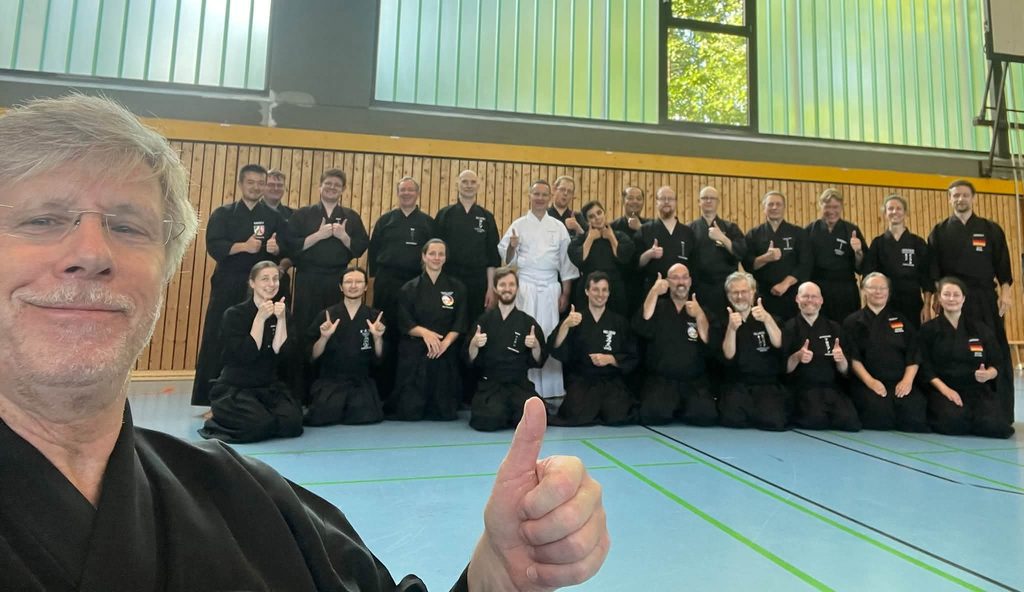
Heijoshin Huglfing nahm am jährlichen Koryu-Seminar des deutschen Zweigs der Ishido-Linie teil.
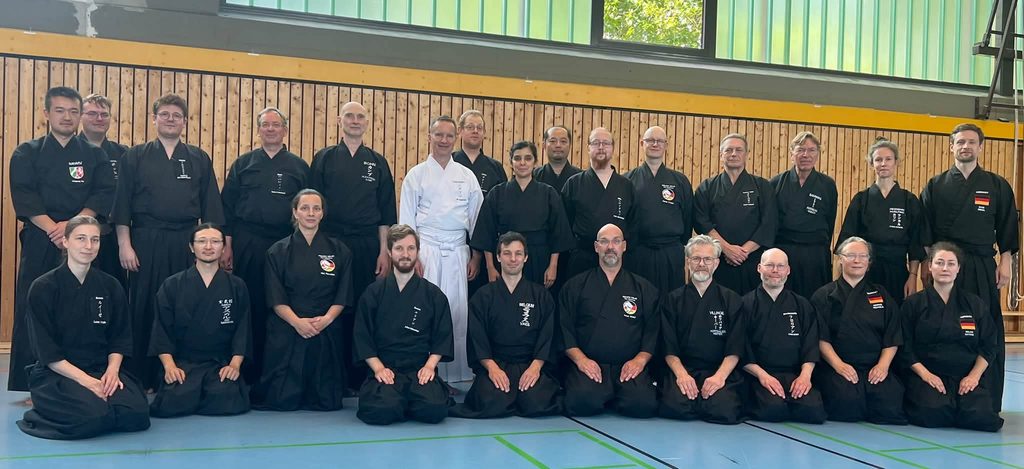
Übungsleiter David Siegel hat einen Bericht darüber geschrieben:
The German branch of the Ishido Line organizes an annual Family (and Friends) Seminar. This year’s edition took place in Essen (Germany) and was hosted by the SyuBuKan dojo in the late summer of 2026 (from the 5th to 6th of September).
It was lead by René van Amersfoort sensei (kyoshi 7th dan iaido, kyoshi 8th dan jodo) and Peter Röder sensei (kyoshi 7th dan iaido, 2nd dan Jodo) who were assisted by Nicolas Vaes sensei (renshi 6th dan iaido, 4th dan Jodo).
The following is just a small summary of the many points and deep topics the sensei shared with the German family.
DAY ONE
In the first line up the differentiation between keitoshisei (for ZNKR) and taito no kamae (for our koryu) were addressed.
After the shomenirei three commands were added to the regular mokuso:
- shisei otadas = correct posture
- kokyu otadas = regulate / calm breathing
- kokoro otadas = clear heart / spirit
The torei was performed according to the Muso Shinden Ryu (MSR) of the Ishido Line.
René sensei deepened the second focus point of breathing in an explanation, demonstration with a volunteer and an anecdote of kancho-sensei.
Speaking of which: how many breath cycles does it take to read a seminar report?
Anyway, from there on sensei used the word/concept of kihaku quite often in correspondence with breathing.
The physical training started with kihon (suburi, noto, chiburi).
The first day was focused on Omori Ryu (or shoden = first transmission) and the first demonstration of Nicolas sensei explained the cluster of kata 1-4 to the group:
- Shohatto
- Sato
- Uto
- Atarito
The principles and details of these kata enabled the training of the fifth:
- Inyoshintai
After almost the first half of the shoden series, the players starting at the EIC presented two kata each they considered for the competition.
So Gyakuto (no. 8) and Seichuto (no. 9) as well as Inazuma (no. 3 of the second transmission) were added to the training programme.
For the first time the differences between shoden and chuden kata were mentioned. To move the center and cut with the body in a somewhat fluent way is even more important in the second series of the MSR curriculum.
Later the group split into two and Peter sensei coached the EIC players with their koryu selection.
The bigger group added Koranto (no. 10) to the training programme, which was practiced in partner exercises addressing the reference of the/an opponent, timing, metsuke, correct transitions and the upholding of the tension.
After keiko we had dinner together at a looong table: family time.
Even on the walk back to the hotel the talk was about teaching, transferring knowledge, skill and perception.
DAY TWO
The second training day started with the repetition of the points concerning reiho and mokuso followed by kihon (suburi, noto, chiburi).
In some exercises the participants checked each other and René sensei mentioned the following concept:
“The teacher is the person in front of you.”
A nice connection to the conversation of the night before!
Today’s focus was on the Hasegawa Eishin Ryu (or chuden = second transmission) and according to René sensei the best warm up or preparation for the second series of MSR is shoden (ref. Day One).
Nicolas sensei demonstrated the first three kata:
- Yokugumo (honwaza, kaiwaza 1 and 2)
- Tora no issoku
- Inazuma
The comments from René sensei and Peter sensei aimed at the kirioroshi action emphasizing to cut a sitting opponent.
After the demonstration of the kata Ukegumo (no. 4) the group was split into beginners and advanced as these four kata were trained.
The beginners worked with Nicolas sensei on the basic sitting in tatehiza, “chuden furikaburi” and the first kata of the series.
Later the advanced group was split again to give the EIC players a chance to work on their kata selection with Peter sensei or to deepen the skill of the chuden series.
Beginners and advanced rejoined again to train Iwanami (kata no. 6) together.
The seminar culminated in the practice of one single kata from the third series, okuden (= inner transmission): Yukitsure.
It was trained in its three stages of the nukiuchi:
- cutting the neck
- cutting down to suigetsu height
- cutting “completely through”
The advice of René sensei on all kata and kihon boiled down to one sentence:
“Move with true intention.”
Every thing in your iai is better doing so, every cut, every step and everything else as well.
We also talked about the apparent contradiction between the preservation of old forms and the personal evolution of the teachers passing on that knowledge, as well as about the importance of staying true to the teachings of Ishido sensei.
So how many breath cycles did it take to read this seminar report? Well, I hope you didn’t count, but read it calm and relaxed. In a natural way, just like you should perform your iai.
Sorry for crudely trying to grasp the essence of the mentioned anecdote of kancho-sensei here.
Anyway I hope you enjoyed the read and got something out of it for you and your iai.
A big thank you to the sensei who shared precious insights with the family about our style strengthening the German connection to the Ishido Line.
Please note that the summarized event, information and advice is specific to our style, repeated incomplete and/or misinterpreted by the author.
Report by David Siegel (5th dan iaido, 5th dan jodo)